By: Boxer Exteriors • Feb 26, 2026 • 12 min. read
A ridge vent is a continuous exhaust vent at the roof peak. It works only with soffit intake, pulling heat and moisture out of Illinois attics year-round.
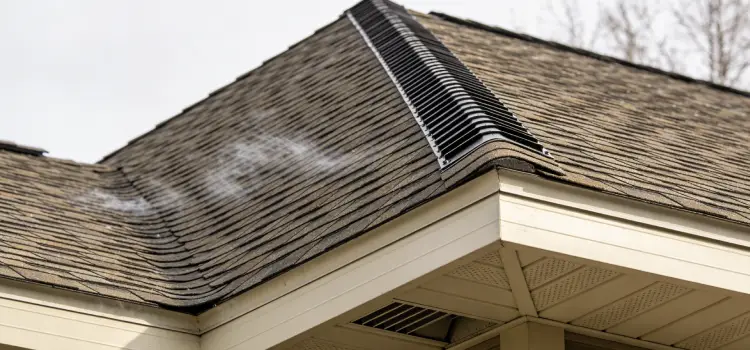
Table of Contents
- 1. Balanced Attic Ventilation: The Rule Most Roof Problems Ignore
- 2. How a Ridge Vent Actually Works: Airflow, Convection, and Wind
- 3. The Two-Part System: Soffit Intake + Ridge Exhaust
- 4. Ridge Vent Design Details That Separate “Works” from “Leaks”
- 5. Materials, Variants, and Compatibility Limits
- 6. Sizing Rules, Calculations, and “Is There Enough Ridge Line?”
- 7. Frequently Asked Questions
When a homeowner asks what is a ridge vent, the simplest answer is this: a roof ridge vent is a long, narrow vent along the roof ridge, installed at the peak. Think of it as a continuous exhaust opening that lets warm, damp air leave the attic. On a typical shingle roof, it runs near the full length of the ridge and provides continuous exhaust at the roof peak instead of “spot” exhaust.
Here’s the catch most people miss: a ridge vent on a roof is not a magic add-on. It only works when it’s part of balanced attic ventilation. The system needs low intake and high exhaust, working together, so airflow through the attic stays steady. A ridge vent without correct intake is like a chimney with no air coming into the room. The exhaust tries to pull, but it cannot pull what the house does not supply.
This guide will explain how convection and wind help a passive attic ventilation system move air, how sizing works, what Illinois winters do to weak setups, which installation mistakes can cause leaks, and when a ridge vent is not the right tool.
Balanced Attic Ventilation: The Rule Most Roof Problems Ignore
The goal is proper attic ventilation and proper roof ventilation that moves air year-round and reduces attic heat and moisture buildup. That steady exchange helps prevent mold and mildew in the attic, lowers summer heat, and supports ice dam prevention with ridge vent ventilation when the rest of the details are right.
Balance is the non-negotiable: balanced intake and exhaust ventilation. The intake usually comes from soffits, so the most common “low-in, high-out” layout is soffit vents and ridge vent working as one system. The practical rule of thumb is to keep slightly more intake than exhaust. Exhaust should not exceed intake, or the ridge vent can start pulling air from the wrong places, like bathroom fans, ceiling cracks, or wall gaps, instead of pulling clean outside air through the soffit vents.
Just as important: keep every vent path open. A soffit vent blocked by insulation, a crushed baffle, a bird nest, or debris turns a good ridge vent into a problem vent. In Illinois, summer humidity plus freeze–thaw winter weather makes “almost balanced” ventilation show flaws fast. Moist air that lingers raises heat stress and moisture risk, then winter cold can turn that moisture into frost inside the attic.
One more rule: don’t mix ridge vents with box vents or gable vents unless a pro designs the whole ventilation plan. Mixing exhaust types can short-circuit airflow and waste ridge vent performance.
How a Ridge Vent Actually Works: Airflow, Convection, and Wind
A homeowner can understand what is a ridge vent by understanding the movement pattern it is designed to create. The goal is steady airflow through the attic, a simple exchange that pushes warm, humid air out and brings cooler, drier air in.. In a well-built system, there is continuous airflow through the attic space from low intake to high exhaust. That’s the entire idea behind a ridge vent on a roof and the reason a roof ridge vent is usually placed at the highest point, the roof peak.
The “engine” is mostly natural. First is the convection principle: warm air rises. In summer, the sun heats the roof deck and the attic warms up. That warm, humid air naturally wants to escape at the top. Second is wind. Wind moving over the ridge creates a low-pressure zone that helps pull airflow out of the ridge vent. For that reason, a ridge vent is considered a passive attic ventilation system. There is no power, no motor, and no switches, just natural movement.
But the ridge exhaust cannot do the work alone. The intake side has to feed it. Fresh intake air must enter low, then push up through the attic so exhaust can leave at the peak. When intake is weak or blocked, the ridge vent still pulls, but it pulls from the wrong places, like ceiling gaps, light fixtures, wall openings, and even bathroom fan housings. That is when a homeowner sees musty smells, moisture, and heat that never seems to leave.
Some homes use mechanical options like powered fans as a mechanical exhaust method. Those can move a lot of airflow, but they also raise risk when the house is leaky or intake is short. A strong fan can depressurize the attic and draw makeup air from indoors. In windy winter weather, a poorly balanced fan setup can also help drive snow or rain where it doesn’t belong. The safer path for many homes is still a balanced passive ventilation plan that fits the roof design and keeps the vent paths clear.
The Two-Part System: Soffit Intake + Ridge Exhaust
Balanced attic ventilation means two components that work as one: intake low, exhaust high. This is the “low-in, high-out” layout that makes proper attic ventilation reliable.
Intake Ventilation at the Eaves
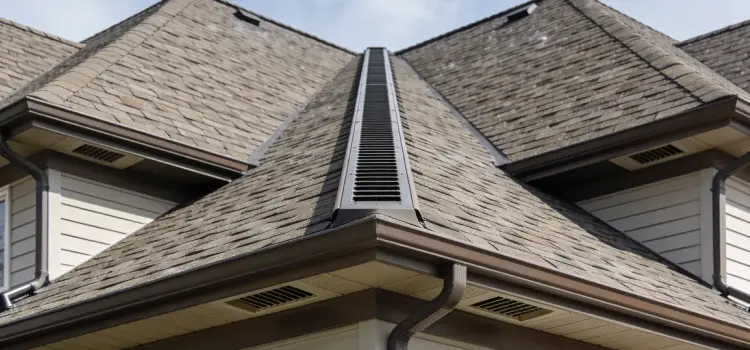
Intake vents sit at or near the soffits. You will see them near the eaves and they are often called eave vents, soffit vents, or intake vents at the bottom of the roof. The job is simple: they supply outside air so the ridge vent has air to exhaust. In a correct setup, soffit vents and ridge vent form a single system. Intake supports exhaust, and the ventilation stays steady instead of fighting itself.
Exhaust Ventilation at the Ridge
Exhaust goes at the top. Ridge vents are installed at the roof peak, running as a long, narrow strip along the ridge line. This creates continuous exhaust ventilation at the roof peak and spreads exhaust across the full ridge instead of relying on a few spot vents. When the intake is correct, this is one of the most effective setups because it is uniform, quiet, and simple.
A practical warning belongs here: don’t mix ridge vents with box vents or gable vents unless a pro designs the full ventilation plan. Mixing exhaust types can short-circuit airflow. Air takes the easiest path, not the best path, and that can reduce the effect of the ridge vent while still leaving heat and moisture trapped.
Ridge Vent Design Details That Separate “Works” from “Leaks”
A ridge vent can be a clean, durable detail, or it can become a leak point. Most ridge vent leaks caused by improper installation come down to a few controllable details.
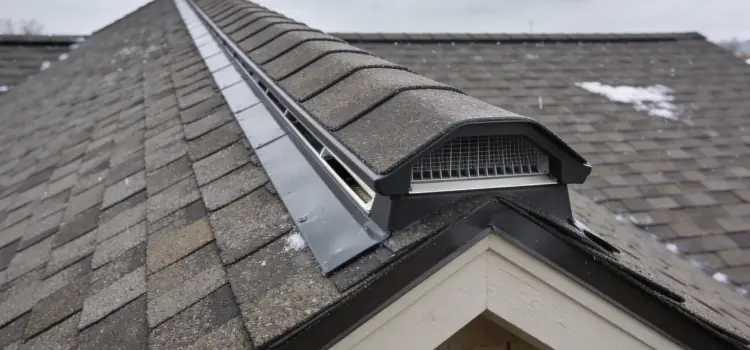
The cut: A proper ridge vent installation starts with a clean air slot cut in the roof deck on both sides of the ridge. Slot sizing matters. Too small and the vent cannot breathe. Too large and the vent may be hard to weatherproof, especially in wind-driven rain and snow.
The cover: Most asphalt systems use ridge cap shingles over the ridge vent, which creates a shingle-over design that blends with the roof. The cap must be nailed correctly, straight, and tight so wind cannot lift it and water cannot track under it. This is also where a low, clean profile helps. A low-profile ridge vent protects curb appeal and reduces wind exposure at the peak.
Baffles: Homeowners should care about ridge vent baffles. A vent with an external baffle tends to pull better in real wind because it creates suction while also deflecting rain and snow. Ridge vents without baffles often have weaker draw and can be more vulnerable in exposed Illinois conditions.
Screens and critter control: A mesh screen for pests and debris matters more than people think. Insects, small animals, and windblown debris can clog a vent path and reduce ventilation. Built-in screening also helps keep the vent opening functioning over time.
In the Chicago suburbs, including Wheaton, Glen Ellyn, Naperville, and nearby areas, Boxer Exteriors checks intake, exhaust, and the ridge detail as one system. A ridge vent that looks good but does not move air is not a solution. It’s simply an opening on the roof.
Materials, Variants, and Compatibility Limits
A homeowner who asks what is a ridge vent usually expects one simple product. In reality, ridge vent materials and designs vary, and the roof shape determines whether a ridge vent will actually do the job.
Most ridge products are durable plastic, but there are also aluminum ridge vents and other metal ridge vents, including galvanized steel. Steel and aluminum ridge vents can be rigid and strong, which helps keep a straight line at the roof peak and resist damage during service work. Plastic can still work well when it has a good external baffle and proper fasteners, but cheap profiles without stiffness can flex, crack, and invite problems.
A special case is retrofitting ridge exhaust on a metal system. Retrofit ridge vents on existing metal roofs are possible, but details matter: how the vent slot is cut, how the metal panels are flashed, and how wind-driven rain is controlled. This is where the wrong ridge vent installation can create leaks fast, because metal sheds water differently than shingles.
Ridge vents work best on roofs with a continuous ridge line, which is typical on gable and hip layouts. That’s where roof design compatibility for ridge vents is strongest. But homeowners should understand ridge vents for gable roofs vs hip roofs: hip roofs often have shorter ridges, which limits exhaust capacity. A short ridge can mean the roof ridge vent can’t provide enough high-level ventilation to match the soffit intake, even if the vent itself is high quality.
Some homes are simply poor candidates. Complex roof shapes not suitable for ridge vents include pyramid roofs, chopped-up hips with tiny ridges, and flat roofs with no true peak line. In those situations, the ridge idea can’t create uniform exhaust, and a different vent strategy may be required.
Interior conditions matter too. A finished or conditioned attic changes the plan because air sealing becomes as important as venting. In low-space assemblies like cathedral ceilings, ridge venting can work, but it often needs careful channel design to keep airflow moving from intake to the peak without dead zones that hold moisture and heat.
Sizing Rules, Calculations, and “Is There Enough Ridge Line?”
Homeowners want a simple answer for how much exhaust ventilation they need. The reality is that ridge vent sizing in linear feet depends on attic area, the product’s net free area (NFA), and whether intake supports it.
Two common benchmarks show up in code and industry rules of thumb:
- 1:150: about 1 sq ft of total NFA per 150 sq ft of attic floor
- 1:300: about 1 sq ft of total NFA per 300 sq ft of attic floor, often used when intake and exhaust are balanced and the ceiling plane is well sealed
The key is balance. Split total ventilation between intake and exhaust, typically with slightly more intake so exhaust never exceeds intake.
Tools homeowners search include an attic ventilation calculator and ridge vent calculator. The inputs that matter are attic square footage, NFA per vent, and the intake to exhaust split. Many ridge vents land around 18 sq in of NFA per linear foot (varies by product). A quick sanity check is to confirm the roof has enough ridge length to carry the exhaust you actually need.
Ridge Vent Length Guide (Quick Planning Sidebar)
Assume:
- 40 to 50 percent of total NFA is exhaust
- Ridge vent is about 18 sq in NFA per linear foot
If the attic is about 1,200 sq ft
- Using 1:300, you often land around 13 to 16 ft of ridge vent
- Using 1:150, you often land around 27 to 33 ft
Then confirm with the product NFA and soffit intake capacity.
If the attic is about 2,000 sq ft
- Using 1:300, you often land around 21 to 27 ft
- Using 1:150, you often land around 44 to 55 ft
Then confirm with the calculator and the actual roof layout.
Here’s the blunt truth. Sometimes there is not enough ridge line. Geometry limits ridge capacity, especially on hip roofs with short ridges. When that happens, forcing a ridge-only plan can reduce performance and fail to reduce attic heat and moisture buildup. Done wrong, it can also increase leak risk at the ridge and make winter problems worse instead of helping with ice dam control.
Boxer Exteriors can perform a ventilation assessment that checks intake and exhaust balance, soffit blockages, insulation depth, and ridge detail integrity. For homes in Wheaton and nearby Chicago suburbs, the recommendation should tie to real attic moisture, summer heat load, and Illinois ice-dam risk, not guesswork.
Frequently Asked Questions
What should homeowners know about a ridge vent before adding one?
A ridge vent is an exhaust vent near the roof peak. It only performs well when the system has enough low intake, usually at the soffits, to support steady airflow. If intake is restricted, the ridge vent can pull from indoor gaps instead of exhausting heat and moisture from the attic. A quick inspection can confirm whether more intake is needed before changing exhaust.
Where is a roof ridge vent installed and what does it do?
A roof ridge vent is installed along the peak of a sloped roof, typically running most of the ridge line. It provides continuous high-level exhaust so hot, damp air can leave the attic evenly. It works with low intake to keep air moving through the space. The layout depends on roof type and attic size, because ridge length can limit exhaust capacity.
How does roof ventilation affect moisture, heat, and ice dams in Illinois?
Attic ventilation is one part of a complete roof performance plan, along with insulation and air sealing. When intake and exhaust are balanced, warm, humid air can leave, which reduces condensation that can feed mold and wood rot. It also lowers summer attic temperatures, which can help shingles last longer. In winter, steady airflow can support ice dam control by helping keep roof deck temperature more even.
What type of ventilation is a ridge vent, and is it powered?
A ridge vent is passive ventilation. It relies on natural forces, not electricity. Warm air rises and wind over the ridge helps pull air out. Intake still has to feed the exhaust, or the system can backdraft from the house. A qualified contractor can verify whether intake area matches the vent’s net free area (NFA).
Should you choose ridge vents or box vents for attic exhaust?
It depends on roof shape, ridge length, and intake capacity. Ridge vents spread exhaust along the ridge for more uniform draw. Box vents exhaust at a few points. Mixing exhaust types can short-circuit airflow if the paths compete. The right call should follow an inspection that checks intake, insulation, and blockages.
What common ridge vent installation mistakes lead to leaks?
Most problems come from the deck slot cut, fastening, and weatherproofing details. If the slot is the wrong width, the vent can underperform or become harder to seal. If the vent is installed crooked or nailed loosely, wind can lift ridge caps and drive water underneath. Best results come from clean cuts, straight installation, compatible ridge caps, proper flashing at nearby transitions, and a vent design that sheds rain and snow in exposed conditions.
Why do ridge vents work better with soffit intake than without it?
Because exhaust needs a reliable supply of outside air. Open, clear soffit intake feeds the attic so air can move upward and exit at the ridge. Without enough intake, the ridge vent can pull from ceiling gaps, light fixtures, or fan housings, which is inefficient and can worsen moisture problems. The system performs best when intake slightly exceeds exhaust.
When should a homeowner install ridge vents during a roof project?
The cleanest time is during a roof replacement, when the deck is exposed and details can be rebuilt correctly. That allows a clean slot cut, a straight install, and matching ridge caps without shortcuts. It also creates a good opportunity to evaluate intake area, insulation depth, and attic moisture. A contractor can confirm whether ridge length and product NFA fit the attic size.
What are the benefits of ridge vents for comfort and roof performance?
When balanced with intake, ridge venting helps reduce heat buildup and humidity, which protects the roof deck and can extend shingle life. Better airflow can limit condensation that leads to wood deterioration and indoor odors. Benefits depend on correct sizing and clear vent paths.
How do vents compare when the roof has short ridges or complex shapes?
Short ridge lines can limit exhaust capacity even with a high-quality vent. Some roof shapes need a different exhaust strategy, especially hip layouts with short ridges or chopped-up rooflines. The goal is still consistent airflow with balanced intake and exhaust. An inspection can confirm whether ridge length is enough for the chosen product and identify better options for the roof geometry and moisture risk.


The team worked efficiently, stayed responsive to phone calls, and were always professional, friendly, and positive. They came highly recommended and truly delivered. We continue to refer them to our friends and neighbors as well.


I highly recommend Boxer Exteriors


Great customer service. Dawn and her team went above and beyond. I highly recommend!!!!!💪🏻💪🏻


The work to the house was handled over two days, one for the roof and another for the siding. No incidents and the end result was seamless. Really came together in the end and have gotten regular compliments on the final outcome.
Overall, couldn’t be happier with my decision to go with Boxer. Professional, trust-worthy, and just overall really good people!